

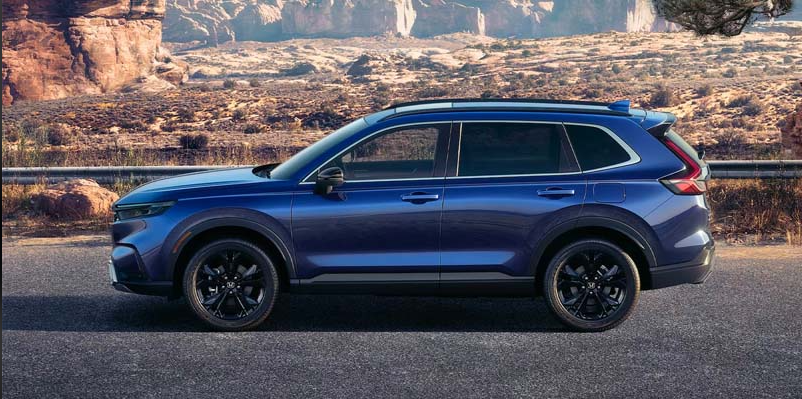
A compact crossover SUV that is smooth-driving, spacious, and refined is the 2024 Honda CR-V Hybrid; but how eco-friendly is it? By association, eco-friendliness makes cars cheaper to run, so it’s something most drivers can get on board with one way or another. The CR-V Hybrid reaches economy figures of up to 43 mpg during city driving and has many eco-friendly features to commend it.
1. Fourth-Generation Hybrid Powertrain
The driving force of CR-V Hybrid eco-friendliness is its 204 hp powertrain. This comprises a 2.0 L DOHC four-cylinder Atkinson cycle engine, two electric motors, and CVT automatic gearing. Simulating old Atkinson cycle principles, the engine uses dual variable timing control (VTC), which delays the closing of the intake valve during each compression stroke, enhancing combustion efficiency.
Introduced with the 2023 CR-V redesign, this powertrain produces less toxic emissions than the previous powertrain through its various improvements. One such improvement was a new low-temperature active catalyst, which cut NOx emissions by 24% and hydrocarbon emissions by 22%, helping the CR-V Hybrid achieve LEV3 SULEV 30 classification (Super Ultra Low Emission Vehicle).
2. Idle-Stop System
Related to the powertrain is the CR-V’s Idle-Stop system. As its name suggests, this switches off the engine at traffic lights or during other brief stops of two seconds or more, further reducing fuel consumption. The engine automatically switches back on when the brake pedal is released.
3. Regenerative Braking
A defining feature of standard hybrid vehicles (HEVs) is their ability to replenish their battery automatically. They capture the kinetic energy created when braking or coasting and convert it into electrical energy. This is one of the great attractions of the CR-V Hybrid and why it’s so economical to drive in cities, where the car will often run on electricity alone and recharges frequently.
4. Predictive Eco-Assist (Sport Touring Trim)
Related to regenerative braking is the Predictive Eco-Assist feature offered with the CR-V Hybrid Sport Touring trim, which utilizes that model’s navigation system. This technology identifies downhill stretches within any set route and optimizes regenerative braking accordingly. The vehicle then draws extra corresponding battery power on flat terrain to reduce engine burden and improve fuel efficiency, based on the route profile.
5. Recycled and Recyclable Parts
Honda has an eco-conscious approach to auto manufacturing. For instance, recycled plastics are always favored over new materials, and non-eco-friendly PVC has been phased out of many parts. The CR-V and all Honda vehicles are made with this ethos in mind.
Contact Coeur d’Alene Honda in Coeur d’Alene, ID to learn more about the environmentally friendly Honda CR-V.
Connect with us


- July 2026
- June 2026
- May 2026
- April 2026
- March 2026
- February 2026
- January 2026
- December 2025
- November 2025
- October 2025
- September 2025
- August 2025
- July 2025
- June 2025
- May 2025
- April 2025
- March 2025
- February 2025
- January 2025
- December 2024
- November 2024
- October 2024
- September 2024
- August 2024
- July 2024
- June 2024
- May 2024
- April 2024
Archives
- 2024 Civic Sedan
- 2024 CR-V Hybrid
- 2024 Honda Civic
- 2024 Honda CR-V
- 2024 Honda HR-V
- 2024 Honda Odyssey
- 2024 Honda Prologue
- 2024 Honda Ridgeline
- 2024 Model Year
- 2025 Civic Hatchback
- 2025 Honda Accord
- 2025 Honda Accord Hybrid
- 2025 Honda Civic Hybrid
- 2025 Honda Civic Sedan
- 2025 Honda Civic Si
- 2025 Honda CR-V
- 2025 Honda CR-V Hybrid
- 2025 Honda HR-V
- 2025 Honda Odyssey
- 2025 Honda Passport
- 2025 Honda Pilot
- 2025 Honda Ridgeline
- 2025 Honda SUV
- 2025 Model Year
- 2026 CR-V Hybrid
- 2026 Honda Civic Hatchback
- 2026 Honda Civic Sedan
- 2026 Honda Civic Sedan Hybrid
- 2026 Honda CR-V
- 2026 Honda CR-V
- 2026 Honda CR-V Hybrid
- 2026 Honda HR-V
- 2026 Honda Odyssey
- 2026 Honda Passport
- 2026 Honda Passport
- 2026 Honda Ridgeline
- 2026 Model Year
- Air Conditioning
- Battery Service
- Coeur d'Alene Honda Dealer
- Coeur d'Alene Honda Service
- Collision Mitigation Braking System
- CR-V
- EV Maintenance
- Financing
- Hatchback
- Honda
- Honda Accessories
- Honda Civic Hatchback
- Honda Leasing
- Honda Maintenance
- Honda Safety
- Honda Service
- Honda Storage
- Honda Trucks
- Hybrid
- Infotainment
- Lane Keeping Assist System
- Minivan
- Oil Change
- Passport
- Road Departure Mitigation
- Roadside Assistance
- Safety Features
- Sedan
- SUV
- Test Drive
- Tire Service
- Transmission Service
- Trim Levels
- Uncategorized
- Warranty